
How to Customize Pregnancy Test Kits for Your Brand: A Complete OEM Guide
For companies entering or expanding in the reproductive health market, offering a pregnancy test under a recognizable brand can be an effective way to build product differentiation and customer loyalty. However, creating a private label pregnancy test is more than simply adding a logo to a standard product. The test format, sensitivity, packaging, instructions, labeling, and production requirements all need to work together to meet the needs of your target market.
A reliable pregnancy test kit manufacturer can help turn your product concept into a finished diagnostic product. With professional OEM and ODM support, brand owners, importers, distributors, pharmacies, and healthcare companies can develop pregnancy test kits that match their market positioning while maintaining consistent manufacturing and quality requirements.
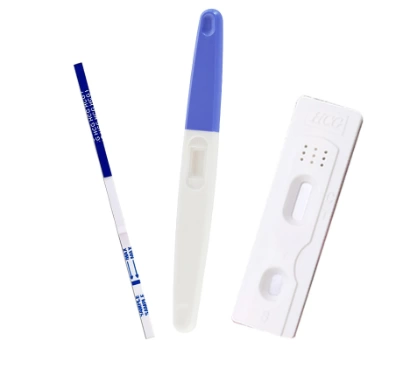
When starting a custom pregnancy test project, the first step is to define the product you want to offer. Pregnancy tests are commonly available in several formats, including test strips, cassette tests, and midstream tests. Each format has a different user experience and packaging requirement. Test strips are often suitable for economical bulk packaging and professional or institutional applications. Cassette pregnancy tests provide a more structured testing format and can be packaged individually or in multi-test boxes. Midstream pregnancy tests are designed for convenient home use and can offer a more consumer-oriented product presentation. Choosing the right format depends on your target customers, price positioning, distribution channels, and intended market.
Sensitivity is another important consideration when developing a customized pregnancy test kit. HCG, or human chorionic gonadotropin, is the hormone detected by pregnancy tests. Different products may be developed around different sensitivity specifications, such as 10 mIU/mL or 25 mIU/mL, depending on the product design and market requirements. Buyers should discuss sensitivity with the manufacturer at the beginning of the project rather than treating it as a simple packaging option. A professional manufacturer can help evaluate the appropriate product specification and provide samples for performance assessment before mass production.
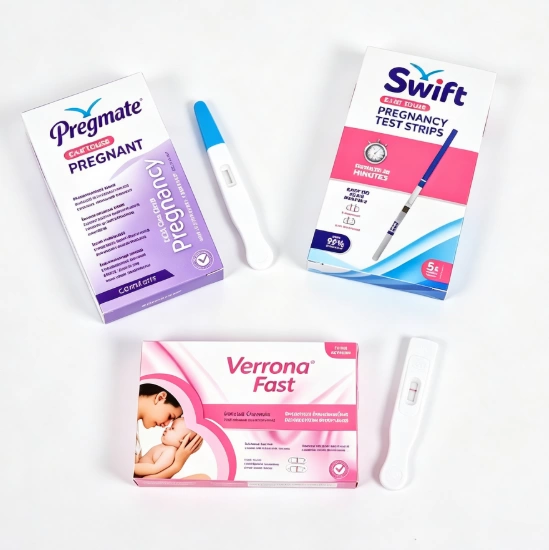
Packaging customization is one of the most visible parts of a private label pregnancy test. For many brands, packaging is the first point of contact between the product and the consumer. Custom packaging can include the brand name, logo, product colors, box design, instructions, product information, barcode, and other market-specific information. Depending on the product format, customized packaging may include individual foil pouches, retail boxes, multi-test packages, or other configurations. The packaging quantity can also be adjusted according to the target market, such as single-test, three-test, five-test, or larger multi-test packs.
Instruction materials should also be considered carefully. A pregnancy test is a diagnostic product, so the instructions need to clearly explain how to use the test, how to interpret the results, and how the product should be stored. For international markets, brands may also need multilingual instructions and labeling. Working with an experienced pregnancy test OEM manufacturer can make it easier to coordinate product information, packaging artwork, and technical documentation during the customization process.
Product appearance is another area where OEM customization can create differentiation. Depending on the product format, companies may be able to customize elements such as housing design, printed markings, dimensions, or other product details that are technically feasible. However, customization should always be balanced with manufacturing stability and product performance. The purpose of customization is not simply to make a product look different, but to create a commercially useful product that can be produced consistently at scale.
For companies launching a new pregnancy test brand, it is also important to consider the relationship between product specifications and local market requirements. Different countries may have different regulatory, labeling, registration, and documentation requirements for in vitro diagnostic products. Before finalizing a customized product, buyers should identify their target countries and discuss the relevant requirements with their manufacturer. This can help reduce unnecessary changes later in the development process.
A professional OEM partner can also support the development process through samples. Instead of moving directly from an idea to mass production, the buyer can first evaluate product samples, packaging samples, appearance, instructions, and overall presentation. Feedback from the buyer can then be incorporated into the final specifications before production. This process is particularly useful for brands that want to create a unique private label pregnancy test rather than simply purchase an existing standard model.
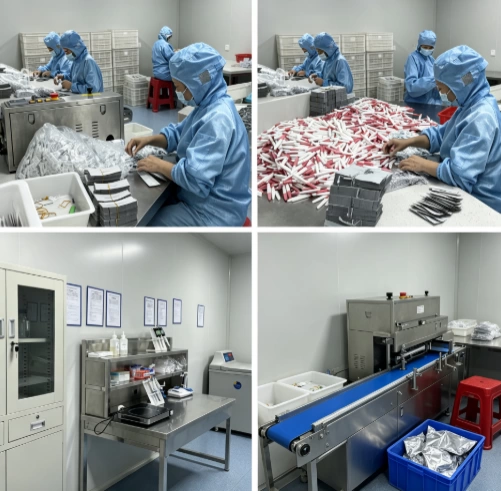
Manufacturing capacity is another key factor when choosing a pregnancy test kit supplier. A product may look excellent during the initial sample stage, but long-term commercial success depends on whether the manufacturer can maintain consistent quality and supply when order volumes increase. MEIBAO operates an IVD manufacturing facility in Jingmen, China, with nearly 40,000 square meters of production space and approximately 200 employees, including nearly 50 mid-to-senior technical professionals. The company states that its annual production capacity for pregnancy and ovulation test products reaches 10 million midstreams, 20 million cassettes, and 30 million strips.
Quality management should also be considered before placing an OEM order. Buyers should evaluate the manufacturer's quality system, available certifications, production controls, testing procedures, and experience with international markets. MEIBAO identifies itself as an IVD manufacturer and lists CE and ISO-related certifications for its pregnancy test products. Its product platforms use sandwich colloidal gold methodology for qualitative HCG detection, with product specifications including 10 mIU/mL and 25 mIU/mL sensitivity options on certain models.
Another advantage of working with an experienced manufacturer is the ability to combine product customization with scalable production. MEIBAO reports experience supporting more than 1,200 OEM clients worldwide and provides customization covering product specifications, sensitivity profiles, packaging, branding, and technical documentation. For a brand owner, this means the OEM project can be managed as a complete product development process rather than as a simple logo-printing service.
Before requesting a quotation, buyers should prepare several basic details. These normally include the preferred test format, sensitivity requirement, target market, packaging quantity, packaging style, private label requirements, estimated order quantity, and any specific regulatory or documentation requirements. Providing these details early allows the manufacturer to recommend a more suitable product configuration and prepare a more accurate quotation.
The customization process can therefore be viewed as a series of practical steps: define the target market, select the test format, confirm technical specifications, develop the packaging and branding, evaluate samples, finalize documentation, approve the final product, and move into mass production. Clear communication at each stage can reduce misunderstandings and help ensure that the finished pregnancy test matches the original business requirements.
For distributors and healthcare companies, private label pregnancy tests can provide greater control over product positioning and brand development. Instead of competing only on the price of a generic product, a customized product can be developed around a specific market segment, retail channel, packaging strategy, and brand identity. For established companies, OEM production can also make it easier to expand an existing reproductive health product line.
MEIBAO provides pregnancy test products in strip, cassette, and midstream formats and supports customized OEM/ODM solutions for international customers. Its manufacturing capabilities, product range, and experience in reproductive health diagnostics provide a foundation for companies looking to develop their own pregnancy test brands.
If you are planning to launch a new pregnancy test brand or customize an existing product line, the best approach is to discuss your requirements with the manufacturer before finalizing the product specification. Share your target market, preferred test format, sensitivity, packaging concept, estimated quantity, and branding requirements. Based on these details, the manufacturer can help determine the appropriate product solution and guide the project from sample development to mass production.
https://www.meibaotest.com/en/company/contact-us
A successful custom pregnancy test is not simply a product with a different logo. It is a combination of appropriate diagnostic performance, practical product design, professional packaging, reliable quality control, regulatory preparation, and stable supply. By choosing an experienced pregnancy test kit manufacturer and defining your requirements clearly from the beginning, your company can build a private label product that is better aligned with its market and long-term business goals.
